
Vegetables are the quiet MVP of any low carb vegetables list. They add volume to your plate, pack nutrients you actually need, and keep meals interesting without blowing your carb budget. Think of them as the seasoning, texture, and health insurance for every meal — not just “stuff on the side.” If you ditch the right veggies, a low carb diet can feel restrictive and bland. Keep the right ones, and it suddenly becomes varied, colorful, and sustainable.
Who this guide is for:
- People new to low-carb eating who want a simple, trustworthy low carb vegetables list.
- Keto followers who need precise net carbs per 100g to stay in ketosis.
- Busy cooks who want quick swaps and recipes that don’t taste like cardboard.
- Anyone who wants to lower carbs without sacrificing fiber, vitamins, or flavor.
Why this matters — in plain language:
- Volume without carbs: Vegetables let you eat a satisfying plate (and feel full) without adding many digestible carbs.
- Micronutrient boost: Low-carb doesn’t mean low-nutrients — veggies supply vitamins, potassium, and antioxidants that many diets miss.
- Blood sugar control: Non-starchy veggies help flatten blood sugar spikes when paired with protein and fat.
- Flexibility: Having a go-to low carb vegetables list makes grocery shopping and meal prep painless.
What you’ll get from this guide:
- A clean, actionable low carb vegetables list with net carbs per 100g so you can compare like for like.
- Practical meal ideas and portion tips for strict keto and more relaxed low-carb plans.
- Simple cooking and storage hacks so vegetables stay tasty and convenient.
- Quick rules for swapping starchy sides (potatoes, rice) with low-carb alternatives that actually satisfy.
Ready to make veggies your secret weapon? You’ll find the pocket-friendly low carb vegetables list that nutritionists, cooks, and busy people use — plus easy ways to turn those veggies into meals you’ll look forward to eating.
How to read this guide: net carbs, serving size, and the 100g standard
This section gives you the quick rules for using the low carb vegetables list like a pro. If you want to track carbs accurately and plan meals without guesswork, these are the habits that save time and keep results consistent.
Quick overview
- Net carbs are the metric most low-carb followers use to compare vegetables.
- We report values per 100 g to make different vegetables comparable.
- Always note whether the value is for raw or cooked — water loss concentrates carbs when you cook.
What “net carbs” means (total carbs − fiber)
Net carbs = total carbohydrates − fiber.
This is used because dietary fiber is not fully digested into glucose and therefore has little effect on blood sugar for most people.
How to calculate net carbs — step by step
- Find the label or database entry for total carbs and fiber (both per 100 g or per serving).
- Subtract fiber from total carbs.
Example calculation (digit-by-digit):
- Suppose a vegetable lists 6.0 g total carbs and 3.5 g fiber per 100 g.
- First, subtract the integer part: 6.0 − 3.0 = 3.0.
- Then subtract the decimal remainder: 3.0 − 0.5 = 2.5.
- Final net carbs = 2.5 g per 100 g.
Practical notes
- Many people use net carbs for keto and low-carb tracking, but some medical plans (or clinicians) may prefer total carbs — follow the approach your health plan or provider recommends.
- When a label lists sugar alcohols (in processed foods), some people subtract them too — that’s outside the scope of this vegetable guide, but worth knowing.
Why do we use per 100g (consistency & tracking)
Using a per 100 g standard is about fairness and clarity:
- Consistency: databases (like USDA FoodData Central) and nutrition labels often use 100 g, so comparisons are apples-to-apples.
- Scalability: if you know a value per 100 g, it’s easy to scale up or down to the portion you actually eat.
How to use it in practice
- Weigh your vegetable portions with a kitchen scale. If the per 100 g number is 3.0 g net carbs and you eat 50 g, you’ve eaten 1.5 g net carbs (3.0 × 0.5 = 1.5).
- If you don’t have a scale, learn common portion weights (e.g., 1 medium zucchini might be ~200 g raw — check a database for exacts).
Raw vs cooked: how water loss changes carb density
Cooking can change the carb density of vegetables because it removes water. That means 100 g cooked of the same vegetable can contain more carbs than 100 g raw, simply because the cooked version is more concentrated.
Key ideas
- Weight changes, carb amount stays the same. If 300 g of raw shrinks to 100 g cooked, the carbs that were spread across 300 g are now concentrated into 100 g.
- Always track the state you ate it in (raw or cooked) and use the matching database entry.
Practical examples & tips
- If you steam a big bunch of spinach, the cooked 100 g will have a higher carb density than 100 g of raw spinach. So:
- Decide: Are you tracking raw or cooked? Stick with one method consistently.
- For leafy greens, it’s often easiest to track raw weights (more predictable). For root veg (carrots, beets), tracking cooked may be more useful if you usually eat them cooked.
- When following the low carb vegetables list, check whether the listed net carbs per 100 g value is raw or cooked. If it’s not specified, assume raw and verify in a trusted database.
Quick checklist (so you don’t forget)
- Always note raw vs cooked on your tracker.
- Use a kitchen scale — it’s the simplest way to be precise.
- Calculate net carbs = total carbs − fiber for each item from your low carb vegetables list.
- When in doubt, look up the exact food entry in a trusted database (search for foodname USDA FoodData Central).
This foundation makes the rest of the low carb vegetables list actionable and reliable — so your meal planning, grocery runs, and tracking are all built on the same rules.
Top 30 low carb vegetables — quick reference table (net carbs per 100g)
Below is a practical, easy-to-scan low carb vegetables list showing approximate net carbs per 100g. These values are rounded estimates you can use for meal planning — always double-check your tracker or USDA FoodData Central for precise numbers, and note raw vs cooked (values below assume typical raw states unless noted).
Two tables: (A) 0–2 g net carbs / 100 g — (B) 2.1–5 g net carbs / 100 g
A) Super low (≈ 0–2 g net carbs / 100 g)
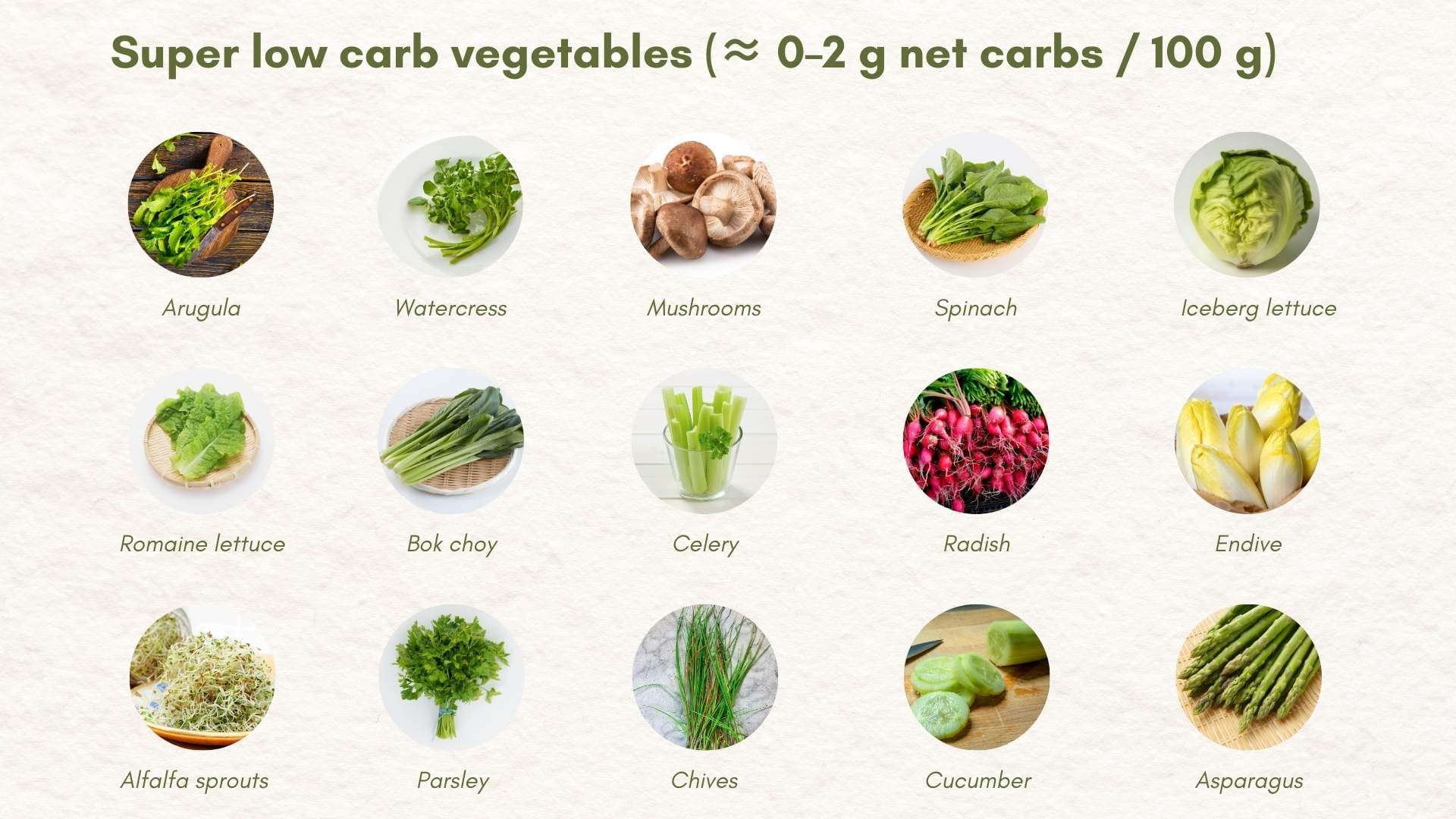
| Veg (raw, typical) | Approx. net carbs / 100 g |
|---|---|
| Arugula | 0.1 g |
| Watercress | 0.4 g |
| Mushrooms (button) | 0.3 g |
| Spinach (raw) | 1.4 g |
| Iceberg lettuce | 1.2 g |
| Romaine lettuce | 1.2 g |
| Bok choy | 1.2 g |
| Celery | 1.4 g |
| Radish | 1.8 g |
| Endive | 0.9 g |
| Alfalfa sprouts | 0.9 g |
| Parsley (fresh) | 1.9 g |
| Chives | 1.9 g |
| Cucumber (peeled) | 1.5 g |
| Asparagus | 2.0 g |
Notes: This group is the bulk of your low carb vegetables list “free” choices. Use them liberally to add volume, crunch, and micronutrients to every meal.
B) Very low to moderate (≈ 2.1–5 g net carbs / 100 g)
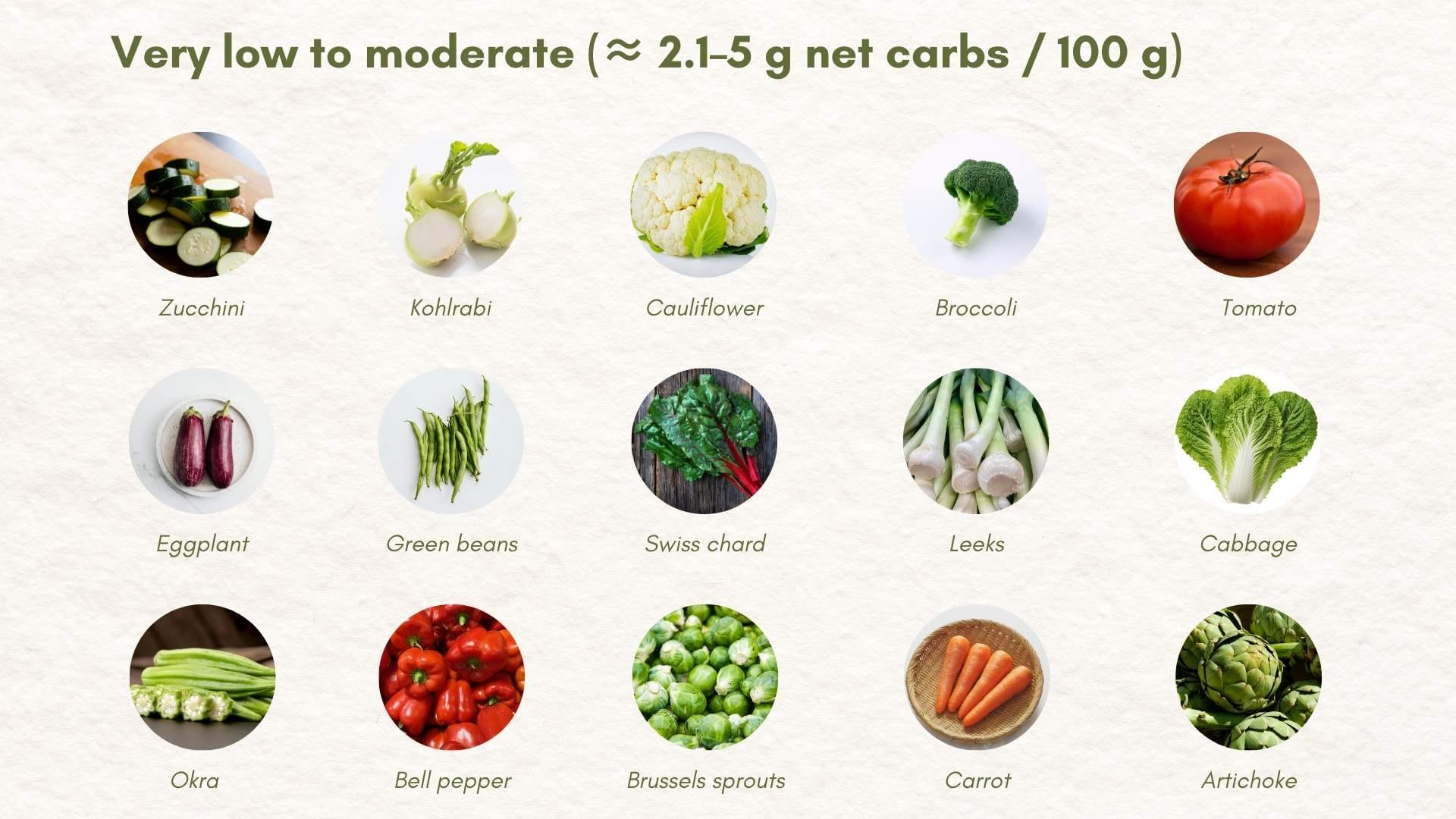
| Veg (raw, typical) | Approx. net carbs / 100 g |
|---|---|
| Zucchini | 2.5 g |
| Kohlrabi | 2.6 g |
| Cauliflower | 3.0 g |
| Broccoli | 3.0 g |
| Tomato | 3.0 g |
| Eggplant | 3.0 g |
| Green beans | 3.4 g |
| Swiss chard | 3.7 g |
| Leeks (white part) | 3.6 g |
| Cabbage (green) | 3.0 g |
| Okra | 3.2 g |
| Bell pepper (green) | 3.0–4.0 g |
| Brussels sprouts | 5.0 g |
| Carrot | 4.8 g |
| Artichoke (globe) | 4.7 g |
Notes: These vegetables are still low-carb friendly but are more carb-dense than the “free” group. On strict keto (e.g., < 20 g net carbs/day) count portions; on more moderate low-carb plans they fit easily.
Quick clarifying points about the table
- Values are approximate and intended for practical meal planning, not clinical decision-making.
- Some vegetables vary by variety, ripeness, and preparation method — e.g., tomato sugar content can vary between cherry and Roma types.
- If you cook a vegetable (steam, roast, sauté), the weight changes due to water loss — the net carbs per 100g will appear higher for the cooked item because it’s concentrated (see “Raw vs cooked” section earlier).
- For maximum accuracy in tight tracking, use a kitchen scale and reference a trusted database (USDA FoodData Central).
How to use the table (meal planning, serving swaps)
Use this low carb vegetables list like a map — not a strict rulebook. Here’s how to put it into action:
- Build plates from the bottom up
- Start with a super low base (e.g., spinach, arugula, cucumber). These add bulk and let you eat a satisfying plate for very few carbs.
- Add one or two very low/moderate veg (e.g., broccoli, bell pepper, cauliflower) for texture and flavor.
- Top with your protein and a calorie-dense fat (olive oil, butter, avocado) to increase satiety.
- Swaps that save carbs (examples)
- Instead of mashed potatoes → cauliflower mash (lowers net carbs drastically).
- Instead of regular pasta → zucchini noodles or spaghetti squash (zucchini is lower-carb).
- Instead of corn/peas → extra broccoli or green beans from the table.
- Portion rules for strict trackers
- If your target is ≤ 20 g net carbs/day, favor items from Table A and keep Table B servings small (e.g., 50–75 g cooked).
- If your target is 20–50 g/day, Table B items are easier to include in larger servings.
- Mix and match for variety
- Rotate colors and textures across the week — e.g., leafy greens, cruciferous veg, and a colorful pepper or tomato — to get different micronutrients and avoid boredom.
- Meal prep & batch cooking tips
- Roast large trays of cauliflower, broccoli, and Brussels sprouts — portion into containers so you can add a veg serving to any meal.
- Pre-spiralize zucchini and store it dry (paper towel) to reduce sogginess — toss into a quick sauté or salad.
- When you need a higher-carb meal
- Schedule starchy veg (sweet potato, beet, potato) around workouts or social meals — they’re not on the low carb vegetables list for strict plans, but have their place if you need extra fuel.
Use the two quick tables above as your foundational low carb vegetables list. For everyday success: keep the super low group as your default, reach for very low/moderate items to add variety, and reserve starchy veg for planned higher-carb occasions.
Deep dive: Vegetables with ~0–1 g net carbs per 100 g (super-low carb options)
These veggies are the workhorses on any low carb vegetables list: tiny on net carbs, big on volume, texture, and micronutrients. Use them as bases, garnishes, or bulk-fillers so you can eat satisfying plates without pushing your carb limits.
Top takeaways (quick):
- These vegetables usually have < 1 g net carbs per 100 g or close to it.
- They’re ideal for salads, garnishes, and large-volume sides.
- They deliver vitamins, minerals, and flavor while keeping net carbs near zero.
- Sources for nutrient data and general benefits: USDA FoodData Central and nutrition authorities like Harvard and Healthline. (1, 2, 3)
Examples — rocket (arugula), watercress, certain leafy greens, mushrooms, celery
(nutrition + recipes/serving ideas)
Below I list each veggie, a short nutrition snapshot (approximate / per 100 g), and simple, tasty ways to use them so they actually make your meals better.
- Arugula (rocket)
- Nutrition snapshot: very low carbs (near 0–2 g net carbs/100 g), rich in vitamin K and nitrates that support blood flow and leafy-green nutrition. (4)
- Serving ideas:
- Use as a peppery salad base with lemon vinaigrette and shaved Parmesan.
- Fold into hot pasta or zucchini noodles at the very end so it wilts slightly (adds freshness + bite).
- Quick recipe: Arugula + lemon + olive oil + toasted pine nuts + a flaked fish or grilled chicken.
- Watercress
- Nutrition snapshot: extremely low in carbs (≈ ~0.8–1.3 g total carbs/100 g depending on source) and dense in vitamin C, calcium, and antioxidants. Great for a high-nutrient, low-carb punch.
- Serving ideas:
- Make a quick watercress pesto (swap basil for watercress) to toss with grilled zucchini ribbons.
- Add handfuls to sandwiches, omelets, or soups right before serving for peppery brightness.
- Spinach (raw)
- Nutrition snapshot: low carb (roughly 1–1.5 g net carbs/100 g depending on calculation), excellent source of vitamin K, folate, and iron like compounds. (5)
- Serving ideas:
- Smoothies with protein powder (use small handfuls if you’re tracking carbs).
- Big sauté: garlic + butter + lemon — serve with roast fish or eggs.
- Make a layered spinach and cheese frittata for meal prep.
- Mushrooms (white/button)
- Nutrition snapshot: very low net carbs (~1–2 g net carbs/100 g depending on fiber assumptions); source of B vitamins, selenium, and (for exposed mushrooms) vitamin D. (6, 7)
- Serving ideas:
- Sauté in butter and garlic as a savory side.
- Use large portobellos as burger “buns” or grill whole as a steak-like side.
- Chop and fold into meat-based sauces or keto-friendly meatloaf to add moisture.
- Celery
- Nutrition snapshot: low net carbs (≈1–2 g net carbs/100 g), mostly water but provides fiber, electrolytes, and crunch. Good for snacks and dips. (8)
- Serving ideas:
- Celery sticks with high-fat dips (cream cheese, nut butter) for snack time.
- Chop fine into salads to add crunch without carbs.
- Use as a base for a low-carb “tuna salad” or chicken salad.
Practical serving & tracking tips for these super-low items
- Portion freedom: Because arugula, watercress, spinach, mushrooms, and celery are so low in digestible carbs, they’re safe to use as the bulk of salads and side plates on most low carb vegetables list approaches.
- Weigh if you’re strict: If you’re on a very tight carb limit (e.g., <20 g/day), weigh portions occasionally — 100 g of raw spinach looks like a LOT, but cooked it shrinks a ton. Use raw weights for leafy greens when possible.
- Pair for stability: Combine these veggies with protein + healthy fat (eggs + butter, chicken + olive oil) to keep meals satisfying and blood sugar steady — a key practical rule echoed by nutrition authorities.
Why these are staples for keto / low-carb cooks
These vegetables appear on nearly every practical low carb vegetables list for good reasons — here’s why cooks and nutrition-minded people use them day after day:
- Volume without carbs — they let you eat a full plate (visual satisfaction + satiety) while using hardly any of your daily net carb allotment. That’s crucial for adherence.
- Micronutrient density — despite low carbs, they deliver vitamins (K, C, folate), minerals (potassium, calcium), and phytonutrients (antioxidants) that many low-carb meal plans otherwise miss. Harvard’s Nutrition Source highlights that emphasizing non-starchy vegetables helps with blood sugar control and overall health.
- Culinary flexibility — they work raw, quickly wilted, roasted, or pureed. This flexibility makes cooking fast and reduces decision fatigue (a real win for busy people).
- Textural contrast — crunchy celery, peppery arugula, and meaty mushrooms make dishes interesting, so low-carb eating feels indulgent rather than restrictive.
- Low cost & easy prep — many of these are inexpensive, store well (especially celery and mushrooms if stored properly), and are easy to batch prep for weekly meal plans.
Quick cookbook-style hacks:
- Keep a bag of washed spinach/arugula and a box of mushrooms in your fridge — you’ll use them in breakfasts, lunches, and dinners without thinking.
- Roast extra mushrooms and broccoli — portion them for fast grab-and-go sides.
- Make a jar of watercress or herb-based dressing to jazz up plain greens quickly.
Vegetables with ~1–3 g net carbs per 100 g — versatile everyday choices
These are the workhorse veggies on any practical low carb vegetables list. They’re low enough in carbs to use regularly, but versatile enough to show up in breakfasts, lunches, dinners, and snacks. Below, I break down each vegetable with quick cooking tips, storage advice, and smart substitutions so you can move from grocery aisle to plate without stress.
Zucchini, cucumber, spinach, asparagus, broccoli
(cooking tips, storage, substitutions)
Zucchini
- Cooking tips:
- Spiralize into zoodles and toss briefly in a hot pan with olive oil — don’t overcook or they turn soggy.
- Halve lengthwise and roast or grill as “boats” for stuffed fillings (cheese, ground meat, or a mushroom ragù).
- Storage: Keep whole zucchini in the crisper drawer for up to a week. Slice only when ready to use.
- Substitutions: Use yellow squash and cucumber (raw dishes) as lower-prep swaps. For a starchy texture swap, try eggplant in baked dishes.
Cucumber
- Cooking tips:
- Best raw: salads, tzatziki, and quick pickles. Peel if you want slightly fewer carbs and a milder flavor.
- Use seeded and chopped cucumber in cold soups or chilled noodle salads.
- Storage: Store unwashed in the fridge crisper wrapped in a paper towel to reduce moisture and prolong crispness (about a week).
- Substitutions: Zucchini ribbons for salads, or celery for crunchy dippers.
Spinach (raw & cooked)
- Cooking tips:
- Raw: huge volume in salads or blended into smoothies (a small handful).
- Cooked: sauté quickly in butter/olive oil with garlic and finish with lemon — great with eggs or fish.
- Storage: Washed baby spinach keeps best in a sealed container with paper towels to absorb excess moisture. Use within 3–5 days.
- Substitutions: Swiss chard or kale (kale is a bit denser in carbs when cooked, so adjust portions).
Asparagus
- Cooking tips:
- Roast at high heat (425°F / 220°C) with olive oil and sea salt for 10–15 minutes until slightly charred.
- Grill or sear, then finish with grated Parmesan or lemon zest.
- Storage: Trim ends and store upright in a jar with a little water (like flowers) to extend freshness for several days.
- Substitutions: Green beans for similar texture and roast ability (green beans are slightly more carb-dense).
Broccoli
- Cooking tips:
- Roast florets on a sheet tray until edges brown — this concentrates flavor and reduces the “raw” grassy note.
- Steam briefly to retain bright color and a firm bite, or blitz into soups and purées.
- Storage: Keep whole heads in the fridge; cut florets last minute to preserve nutrients. Use within 5–7 days.
- Substitutions: Cauliflower for lower-carb rice like swaps, or broccolini for a milder, thinner-stemmed option.
How to bulk meals with these without spiking carbs
Want big, satisfying plates without adding a lot of digestible carbs? Use these practical strategies to bulk meals from your low carb vegetables list while keeping net carbs low.
- Layer low-carb volume first
- Build the base of your plate with spinach, arugula, or zucchini ribbons — they take up space and add fiber so you feel full faster.
- Add a moderate portion of a denser veg
- Use broccoli or cauliflower as the second layer (roasted or riced) to mimic a starchy side without the carb hit. Keep portions to 75–100 g cooked for strict tracking.
- Bulk with water-rich veg
- Cucumber and celery are great crunchy fillers for salads and bowls — they add chew and hydration with almost no net carbs.
- Use high-fat condiments to increase satiety
- Toss veg in olive oil, avocado, or a creamy dressing. Fats slow digestion and help you feel full longer — so you don’t keep eating to chase satisfaction.
- Swap, don’t add
- Replace, don’t add: swap a cup of rice or potatoes for two cups of roasted broccoli + cauliflower. This keeps the plate full without adding net carbs.
- Mix textures and temperatures
- Combine raw crunchy veg (cucumber, celery) with warm roasted veg (asparagus, broccoli) and a creamy element (avocado, aioli). The variety reduces the urge to snack later.
- Batch-prep veg for effortless plates
- Roast a large tray of mixed zucchini, broccoli, and asparagus on Sunday — portion into containers so every meal gets a ready-made bulk of low-carb veg.
Quick checklist for bulking meals (so you don’t overcount carbs):
- Prefer raw weights for leafy greens; use cooked weights for roasted cruciferous veg.
- Keep a kitchen scale handy for strict days — eyeballing can add unexpected carbs.
- Aim for at least one super low and one moderate veggie per plate to balance volume and flavor.
Using these strategies, your low carb vegetables list becomes a tactical tool: big plates, bright flavors, and steady energy — without blowing your carb target.
Vegetables with ~3–5 g net carbs per 100 g — moderate but useful options
These vegetables are winners for flavor, color, and nutrition — they just ask that you be a little mindful about portion size if you’re following a strict plan. Use this part of the low carb vegetables list to add interest and variety: toss a few tomatoes into a salad, roast a pan of Brussels sprouts for dinner, or make cauliflower mash instead of potatoes. Below you’ll get practical recipes, portion tips, and real-world guidance so these veg work for you — not against your macros.
Tomatoes, bell peppers, cauliflower, Brussels sprouts
(recipes & portion tips)
Tomatoes
- Quick facts: A typical 100 g tomato contains about 3.9 g total carbs with roughly 1.2 g fiber (net ≈ 2.7–3.9 g depending on variety).
- Why include them: They add acidity, moisture, and umami (when roasted), plus antioxidants like lycopene.
- Portion tip: One medium tomato (~100 g) is fine for a moderate low-carb day; on strict keto (≤20 g net carbs/day), count it as ~3 g net carbs.
- Recipe idea: Roasted cherry tomatoes — toss 150 g cherry tomatoes with olive oil, garlic, and thyme; roast at 400°F for 15–18 minutes and spoon over grilled fish or zucchini noodles.
Bell peppers
- Quick facts: Net carbs vary by color (green tends to be lowest). A 100 g green bell pepper is roughly 2.9–3.0 g net carbs; red and yellow varieties are slightly higher.
- Why include them: High in vitamin C and color; great raw in salads or roasted in fajita-style bowls.
- Portion tip: Half a medium bell pepper (≈60 g) is ~1.8 g net carbs — a smart way to add flavor without a big carb hit.
- Recipe idea: Stuffed bell halves — fill with seasoned ground meat, cauliflower rice, and cheese; bake until bubbly for a balanced, colorful dinner.
Cauliflower
- Quick facts: Cauliflower is one of the most useful items on any low carb vegetables list — typical values are ~5 g total carbs and ~2 g fiber per 100 g, leaving ~3 g net carbs per 100 g (raw).
- Why include it: Super versatile — rice it, mash it, or use it for pizza crusts. Nutritionally, it provides vitamin C and fiber while keeping carbs reasonable.
- Portion tip: 150 g cauliflower rice is a generous side with only ~4–5 g net carbs — great swap for grains or starchy sides.
- Recipe idea: Creamy cauliflower mash — steam 300 g cauliflower, blend with butter, cream, and a little grated Parmesan; season with black pepper and chives.
Brussels sprouts
- Quick facts: Raw Brussels sprouts contain around 8–9 g total carbs per 100 g and roughly 3–4 g fiber, yielding a net carb figure often near 5 g per 100 g (values vary by source). Count portions carefully if you’re tight on carbs.
- Why include them: When roasted, they caramelize and become addictively savory; they’re also high in vitamin C and K.
- Portion tip: A small serving (75 g roasted) gives flavor and texture with roughly 3–4 g net carbs — nice as a side when balanced with higher-fat protein.
- Recipe idea: Bacon roasted Brussels sprouts — halve sprouts, toss with olive oil and pepper, roast until crisp, then toss with crumbled cooked bacon and a splash of apple cider vinegar.
When to count them strictly (strict keto vs moderate low-carb)
Not all low-carb approaches are the same. Here’s how to decide when to be strict with the low carb vegetables list and when you can relax a bit:
- Strict ketogenic approach (≈ ≤20 g net carbs/day):
- Treat tomatoes, bell peppers, cauliflower, and Brussels sprouts as foods to measure and count.
- Favor smaller portions of the moderate group (e.g., 50–100 g servings) and prioritize super low veg to bulk your plate.
- Example: If you aim for 20 g net carbs/day and have a 100 g serving of cauliflower (~3 g net carbs) plus a 100 g tomato (~3 g), that’s ~6 g used — plan the rest of the day accordingly.
- Moderate low-carb approach (≈ 20–50 g net carbs/day):
- You can be more liberal — 150–200 g portions of cauliflower or a medium tomato are usually fine and help keep meals satisfying. These vegetables become tools for variety rather than tight constraints.
- General rules-of-thumb for counting:
- Always check whether the carb values you’re using are for raw or cooked weights. Cooking concentrates carbs by reducing water, so 100 g cooked may contain more carbs than 100 g raw of the same vegetable.
- Use a kitchen scale for precision on strict days. If you don’t want to weigh, default to smaller portions (half a bell pepper, 75–100 g cauliflower) to stay safe.
- Pair with fat & protein. Eating these vegetables with a fat (butter, olive oil, avocado) and protein (chicken, fish, eggs) slows digestion and blunts glycemic responses, making portion flexibility easier.
Quick practical checklist
- Use the low carb vegetables list as a tool, not a rulebook: pick from super low options for bulk, and add moderate veg for flavor.
- On strict keto, measure tomatoes, peppers, cauliflower, and Brussels sprouts and log them.
- On moderate low-carb plans, enjoy larger portions while keeping overall daily carbs in mind.
- When in doubt, check USDA FoodData Central or similar trusted databases for exact net carbs per 100 g for the variety and state (raw vs cooked) you’re eating.
Vegetables to limit or avoid on strict low-carb / keto
When your goal is ketosis or a very low daily net carb cap (for example, ≤20 g/day), some vegetables that are nutritious in other diets become risky because of their high digestible carbohydrate load. Below, I cover the common culprits, why they matter, and practical swaps so you don’t feel deprived.
Starchy roots & tubers — potatoes, sweet potatoes, corn, parsnips
Why they’re a problem on a strict low-carb:
- These are starch-dense foods — most of their carbohydrates are digestible and raise blood glucose, which can quickly use up your daily net carb allowance.
- A typical serving (one medium potato or sweet potato) can equal or exceed an entire day’s carb budget on strict keto.
Typical characteristics (what to expect):
- Highly digestible carbs per 100 g (substantially higher than non-starchy veggies).
- Higher glycemic impact — faster blood sugar response than leafy greens or crucifers.
- Usually used as “starchy sides” (mashed, roasted, fries), so portion control is hard.
Practical guidance & portion tips:
- Avoid these as default sides on strict keto days. If you want them occasionally, plan them into a higher-carb “refeed” day or around heavy training sessions.
- If you must include one, keep the portion tiny — think tablespoons, not cups — and pair with large amounts of non-starchy veg, protein, and fat to blunt the glucose spike.
- Consider timing them for when you need performance fuel (pre/post long workouts) rather than as everyday staples.
Flavorful low-carb swaps (keep the texture/comfort):
- Cauliflower mash instead of mashed potatoes.
- Roasted cauliflower or turnip instead of roasted potatoes.
- Spaghetti squash or zucchini noodles instead of pasta-style starches.
- For “fries,” try baked turnip sticks or rutabaga in small portions — they’re still more carb-dense than cauliflower, so measure.
Cooking tips to mimic starchy comfort:
- Roast cauliflower at high heat to get caramelization and a slightly sweet, roasty flavor.
- Add butter, cream, or cheese to cauliflower mash to replicate the richness of mashed potatoes without the carbs.
Legumes/peas — and why their carb profile matters
What legumes bring (and cost):
- Beans, lentils, chickpeas, and many peas are protein-rich and fiber-rich, but they also contain substantial amounts of starch and sugars. That means their net carbs can be high enough to kick someone out of ketosis in typical serving sizes.
- For many people, a small bowl of lentil soup or a ½ cup of chickpeas uses up a large portion of a strict daily carb limit.
Why do some people still use them:
- If you follow a moderate low-carb or plant-focused approach (rather than strict keto), legumes are a valuable source of protein, fiber, and micronutrients.
- Athletes or people doing intense training sometimes include legumes strategically for glycogen replenishment.
Practical guidance & portion tips:
- On strict keto: treat legumes as a treat or reserve them for targeted carb days. If you include them, keep servings very small (e.g., a tablespoon or two) and log the net carbs.
- On moderate low-carb: small to moderate portions (¼–½ cup) can fit within a 20–50 g/day plan — just track them.
- If you rely on legumes for protein (vegetarian/vegan), be mindful that staying in strict ketosis is much harder — consider higher fat plant options and smaller legume portions.
Smart ways to get benefits without the carb hit:
- Use edamame or green beans sparingly — they are lower carb than many dried beans, but still need portions counted.
- For texture in salads or bowls, try roasted chickpea seasoning flavors using sautéed cauliflower or diced roasted turnip for crunch.
- Combine a very small legume portion with plenty of non-starchy veg and fat to slow digestion.
Quick decision checklist (so you don’t overthink it)
- If your daily net carb target is ≤20 g, limit or avoid starchy tubers and most legumes.
- If your target is 20–50 g, you can include small portions of higher-carb veg but log them and balance your day.
- For performance or refeed needs, schedule starchy veg around workouts — don’t treat them as daily staples on strict keto.
- Always pair higher-carb veg with protein and fat to blunt blood sugar spikes.
Final practical swaps & meal hacks
- Swap mashed potatoes → cauliflower mash + butter + chives.
- Swap rice or grains → riced cauliflower or sautéed broccoli “rice.”
- Swap a bean salad side → diced roasted vegetables with nuts/seeds for crunch and extra fat.
- If you crave a starchy bite occasionally, plan a small, timed serving and log the carbs so it’s a deliberate choice, not an accidental carb blowout.
Nutritional benefits beyond carbs: fiber, vitamins, minerals, phytonutrients
Vegetables do way more than just keep your net carbs low — they’re micronutrient powerhouses. A smart low carb vegetables list gives you fiber for gut health, vitamins for immunity and bone health, minerals for electrolytes, and phytonutrients (special plant compounds) that support long-term health. Below, I break down the top low-carb picks for specific nutrients and explain the unique compounds to look for — plus practical tips so you actually get those benefits on your plate.
Top low-carb vegetables for vitamin C, K, folate, potassium, magnesium
Here’s a quick, usable cheat sheet — the best low-carb veg to prioritize when you want specific nutrients. I’ll list the nutrients, top vegetables from a low carb vegetables list, why they matter, and a simple serving idea.
- Vitamin C — (immune support, antioxidant)
- Top low-carb sources: bell peppers (especially red), broccoli, Brussels sprouts, cauliflower.
- Why it matters: Vitamin C supports immune function, collagen production, and acts as an antioxidant.
- Serving idea: roast broccoli and bell pepper strips with garlic; squeeze lemon on top for an extra C boost.
- (Vegetables overall are a central part of a balanced daily plan to maintain vitamin C without adding starch.)
- Vitamin K — (blood clotting, bone health)
- Top low-carb sources: spinach, kale, Swiss chard, broccoli, Brussels sprouts.
- Why it matters: Vitamin K is crucial for bone metabolism and blood clotting; leafy greens are the top natural sources.
- Serving idea: toss a big handful of spinach into eggs or smoothies, or steam kale and finish with a drizzle of olive oil. (9)
- Folate (vitamin B9) — (cell division, neural support)
- Top low-carb sources: spinach, asparagus, Brussels sprouts, broccoli.
- Why it matters: Folate is important for cell growth and DNA repair — useful for anyone, but especially important for people planning pregnancy.
- Serving idea: asparagus + poached egg = folate-rich breakfast that’s low on net carbs.
- Potassium — (electrolyte balance, blood pressure regulation)
- Top low-carb sources: spinach, Swiss chard, broccoli, mushrooms, avocado (not a vegetable but commonly paired).
- Why it matters: potaPotassiumps balance sodium and supports healthy blood pressure; it’s particularly important on low-carb diets because reduced insulin can change electrolyte needs.
- Serving idea: make a spinach and mushroom sauté tossed with avocado slices for a potassium-rich side. (10)
- Magnesium — (muscle, nerve function, sleep)
- Top low-carb sources: spinach, Swiss chard, broccoli, artichoke (portion controlled).
- Why it matters: magnesium supports muscle and nerve function and plays a role in sleep and mood regulation; many people are borderline low in magnesium.
- Serving idea: steam Swiss chard briefly and toss with toasted seeds (if your plan allows) or add to an omelet. (11)
Practical tip: mixing leafy greens (spinach, arugula) with a crucifer (broccoli, cauliflower) gives you a broad micronutrient spread with minimal carbs. When you build meals around these, you’re getting a lot of nutrition for very little net carb cost.
Antioxidants and unique compounds (e.g., sulforaphane in broccoli)
Beyond vitamins and minerals, many low carb vegetables contain phytonutrients — plant chemicals with antioxidant and signaling roles in the body. One of the best known in cruciferous veggies is sulforaphane.
- Why sulforaphane matters:
- It’s been studied for anti-inflammatory and antioxidant effects and shows biological activity in lab and some clinical studies (including impacts on oxidative stress and inflammation). Research suggests sulforaphane may influence cellular defense systems and even support brain and metabolic health in certain settings.
- Where to find it:
- Broccoli (especially broccoli sprouts), Brussels sprouts, cabbage, cauliflower, and kale are good cruciferous sources.
- How to maximize sulforaphane when you cook:
- Chop and rest: chop cruciferous vegetables (like broccoli) and let them sit ~10–90 minutes before cooking — this helps the plant enzyme (myrosinase) convert precursors into active sulforaphane.
- Don’t overcook: high heat and long cooking can reduce the active compounds. Light steaming or quick stir-frying preserves more activity than prolonged boiling.
- Add mustard seed or powder if needed: mustard contains myrosinase and can help when using frozen or overcooked crucifers.
- These practical prep tips can increase the health payoff from cruciferous veg without adding carbs.
- Other notable phytonutrients in low-carb veg:
- Lycopene (tomatoes) — an antioxidant associated with heart and prostate health.
- Anthocyanins (purple/red cabbage, radishes) — linked to anti-inflammatory and metabolic benefits.
- Lutein & zeaxanthin (spinach, kale) — supportive for eye health.
- Including colorful, low-carb vegetables across meals diversifies these protective compounds.
Actionable takeaway: aim for variety — a daily mix of leafy greens, cruciferous veg, and one colorful vegetable (red pepper or tomato) will cover most antioxidant bases while staying low-carb. Light cooking and simple prep (chop & rest for crucifers) helps you get more of the good stuff.
Quick summary checklist (so you can use this right away)
- Prioritize spinach, broccoli, kale, Brussels sprouts, and bell peppers on your low carb vegetables list to hit vitamin C, K, folate, potassium, and magnesium.
- Use chop & rest and light steaming to preserve and activate sulforaphane in cruciferous vegetables.
- Build meals that combine leafy greens + cruciferous veg + a colorful pepper/tomato for maximum nutrient coverage with minimal carbs.
Practical meal planning: 7-day low-carb veg-focused meal plan
Below is a practical, ready-to-use 7-day plan built around a low carb vegetables list. Each day shows breakfast, lunch, dinner, and a snack — with exact vegetable portions (grams) and approximate net carbs per serving so you can track easily. All net carb estimates are calculated from common per-100 g values (rounded) — they’re approximate and meant for practical planning.
Quick note: I use these estimated net carb per 100g baselines for the plan: spinach 1.4, zucchini 2.5, arugula 0.1, asparagus 2.2, broccoli 3.0, cucumber 1.5, mushrooms 0.3, cauliflower 3.0, bell pepper 3.5, celery 1.4, tomato 3.0, eggplant 3.0, brussels 5.0, carrot 4.8. Values are rounded for clarity.
Day 1 — Daily veg net carbs ≈ 11.18 g
- Breakfast
- Spinach — 50 g → ~0.7 g net carbs
- (e.g., spinach omelet)
- Lunch
- Zucchini — 150 g → ~3.75 g
- Arugula — 30 g → ~0.03 g
- (zucchini noodle bowl with olive oil + protein)
- Dinner
- Asparagus — 100 g → ~2.2 g
- Broccoli — 100 g → ~3.0 g
- (roast asparagus + broccoli with salmon)
- Snack
- Cucumber — 100 g → ~1.5 g
Day 2 — Daily veg net carbs ≈ 12.32 g
- Breakfast
- Mushrooms — 80 g → ~0.24 g
- Spinach — 40 g → ~0.56 g
- Lunch
- Cauliflower (riced) — 150 g → ~4.5 g
- Dinner
- Bell pepper — 100 g → ~3.5 g
- Broccoli — 80 g → ~2.4 g
- Snack
- Celery — 80 g → ~1.12 g
Day 3 — Daily veg net carbs ≈ 10.98 g
- Breakfast
- Spinach — 60 g → ~0.84 g
- Lunch
- Zucchini — 150 g → ~3.75 g
- Tomato — 80 g → ~2.4 g
- Dinner
- Cauliflower (roasted) — 200 g → ~6.0 g
- Snack
- Arugula — 50 g → ~0.05 g
(Tip: swap a smaller cauliflower portion if you want a lighter carb day — 150 g reduces the day total by ~1.5 g.)
Day 4 — Daily veg net carbs ≈ 9.94 g
- Breakfast
- Mushrooms — 70 g → ~0.21 g
- Spinach — 40 g → ~0.56 g
- Lunch
- Broccoli — 150 g → ~4.5 g
- Dinner
- Eggplant — 150 g → ~4.5 g
- Bell pepper — 80 g → ~2.8 g
- Snack
- Cucumber — 100 g → ~1.5 g
(Use eggplant slices grilled with olive oil for a satisfying dinner side.)
Day 5 — Daily veg net carbs ≈ 9.37 g
- Breakfast
- Spinach — 50 g → ~0.7 g
- Lunch
- Asparagus — 120 g → ~2.64 g
- Arugula — 30 g → ~0.03 g
- Dinner
- Zucchini — 120 g → ~3.0 g
- Cauliflower — 100 g → ~3.0 g
- Snack
- Celery — 80 g → ~1.12 g
Day 6 — Daily veg net carbs ≈ 14.18 g
- Breakfast
- Spinach — 60 g → ~0.84 g
- Lunch
- Broccoli — 120 g → ~3.6 g
- Tomato — 100 g → ~3.0 g
- Dinner
- Brussels sprouts — 100 g → ~5.0 g
- Mushrooms — 80 g → ~0.24 g
- Snack
- Cucumber — 100 g → ~1.5 g
(Brussels are delicious roasted with olive oil and a splash of lemon — tasty but pack a higher carb punch, so portion carefully.)
Day 7 — Daily veg net carbs ≈ 15.73 g
- Breakfast
- Spinach — 50 g → ~0.7 g
- Lunch
- Zucchini — 150 g → ~3.75 g
- Dinner
- Cauliflower — 200 g → ~6.0 g
- Broccoli — 80 g → ~2.4 g
- Snack
- Carrot — 60 g → ~2.88 g
Quick week summary (shopping quantities — veg totals for the 7 days)
These are the approximate vegetable amounts needed for the week (grams), plus friendly unit conversions you can follow when shopping:
- Spinach — 350 g (~12 oz / 1 large bunch or 2 small salad bags)
- Zucchini — 570 g (~3–4 medium zucchini)
- Arugula — 110 g (~1 bag / small bunch)
- Asparagus — 220 g (~1 bunch)
- Broccoli — 530 g (~2–3 heads or 3 packages of florets)
- Cucumber — 300 g (~2 medium cucumbers)
- Mushrooms — 230 g (~1 package)
- Cauliflower — 650 g (~2 medium heads or 3 bags riced cauliflower)
- Bell pepper — 180 g (~2 medium peppers)
- Celery — 160 g (~1 stalk/bunch)
- Tomato — 180 g (~2 medium tomatoes)
- Eggplant — 150 g (~1 small)
- Brussels sprouts — 100 g (~8–10 sprouts)
- Carrot — 60 g (~1 medium carrot)
Tip: buy slightly more broccoli/cauliflower and spinach than the totals — they’re the week’s workhorses and store/cook well.
Shopping list & prep tips (make the week effortless)
Shopping checklist (one-glance):
- Leafy greens: spinach (350 g), arugula (110 g)
- Cruciferous: broccoli (530 g), cauliflower (650 g)
- Zoodles & crunchy veg: zucchini (570 g), cucumbers (300 g), celery (160 g)
- Flavor veg: bell peppers (180 g), tomatoes (180 g), mushrooms (230 g), eggplant (150 g)
- Special: asparagus (220 g), Brussels sprouts (100 g), carrot (60 g)
Prep & batch-cook tips (time-savers):
- Wash and dry greens: wash spinach and arugula, spin or pat dry, store in a sealed container with a paper towel to absorb moisture. This keeps them crunchy and ready for eggs or salads.
- Batch roast crucifers: toss broccoli + cauliflower with oil, roast a large tray at 425°F for 20–25 minutes. Divide into 3–4 containers for quick reheats and bowls.
- Rice cauliflower once: pulse raw cauliflower in a food processor and store riced portions in the fridge (or freeze in flat bags). Quick to stir-fry as a rice swap.
- Pre-spiralize zucchini: spiralize just before use when possible, but if you must prep early, keep dry and separated by a paper towel to reduce sogginess.
- Trim & store asparagus: trim ends, stand the stalks in a jar with an inch of water, and cover with a plastic bag in the fridge — they’ll keep crisp longer.
- Sauté mushrooms in bulk: pan-sear with garlic and butter, portion for breakfasts and stir-ins. Mushrooms reheat well.
- Prep snack packs: celery sticks, cucumber slices, and small snack bags of roasted broccoli make it easy to snack without reaching for carbs.
- Label containers: write date and portion size on each container (e.g., “Broccoli — 150 g”) for fast carb logging.
Meal-assembly hacks
- Build plates using the “bulk + treat” idea: super low veg (spinach/arugula) as base + one moderate veg (broccoli/cauliflower) + protein + fat. This keeps daily net carbs moderate and meals satisfying.
- Use fats liberally (olive oil, butter, avocado) — they increase satiety and make low-carb veg feel indulgent.
- If you need more carbs for workouts or social meals, swap a controlled cauliflower portion for a small sweet potato — schedule this intentionally.
Final notes & tracking reminder
- The daily totals above (≈ 9–16 g net carbs/day from vegetables) exclude carbs from fruit, dairy, nuts, sauces, or starchy sides — add those when you log meals.
- The plan centers on the low carb vegetables list mindset: pick high-volume, low-net-carb veg for satiety + a few moderate items for flavor.
- For absolute accuracy, check each item’s net carbs per 100 g in USDA FoodData Central and weigh portions consistently (raw vs cooked).
Cooking and storage tips to keep net carbs manageable (and flavor high)
Keeping net carbs low doesn’t mean boring food. With a few smart cooking tricks and storage habits, your low carb vegetables list can taste amazing and be ready-to-eat all week. Below are practical, kitchen tested tips — temperatures, timings, quick recipes, and storage rules that preserve nutrients, texture, and flavor while making tracking easy.
Roasting, spiralizing, ricing cauliflower, sautéing, pickling
Roasting (why it’s magic & how to do it right)
Roasting concentrates flavor, caramelizes natural sugars, and makes even simple veg feel indulgent — without adding carbs.
- Basic method:
- Preheat oven to 425°F (220°C).
- Toss florets or cut veg in 1–2 tbsp olive oil per 500 g, salt, and aromatics (garlic, smoked paprika, thyme).
- Spread in a single layer on a rimmed sheet pan (don’t overcrowd).
- Roast 18–30 minutes, depending on veg and size — flip halfway for even browning.
- Veg and suggested times:
- Broccoli/cauliflower florets: 20–25 min.
- Brussels sprouts (halved): 20–25 min.
- Zucchini slices: 12–18 min (watch closely — they get soft fast).
- Flavor boosts: finish with lemon zest, grated Parmesan, or toasted nuts/seeds (if your carb budget allows).
Spiralizing (zoodles & texture tips)
Zucchini and other squash are perfect for replacing pasta; do this right, and they won’t get watery mush.
- Choose firm, medium sized zucchini (not overly large or seedy).
- Spiralize fresh; if prepping ahead:
- Salt lightly, let sit 10–15 minutes in a colander to draw water, then gently squeeze or pat dry with paper towels.
- Store dry with a paper towel between layers to absorb moisture.
- Quick cook: toss zoodles in a hot skillet 60–90 seconds with a splash of oil — just to warm. Overcooking causes limp, watery noodles.
Ricing cauliflower (two methods & texture notes)
Cauli-rice is the most useful swap on any low carb vegetables list. Keep it fluffy, not soggy.
- Food processor method:
- Chop cauliflower into chunks and pulse in a food processor in short bursts until rice-sized. Don’t over process, or it becomes mush.
- Box grater method:
- Use the large holes of a grater for a similar result if you don’t have a processor.
- Cooking:
- Sauté 4–6 minutes in a hot pan with oil and a pinch of salt for a dry, fluffy texture.
- Alternatively, microwave 2–3 minutes covered — then drain any excess water.
- Freezing: blanch briefly (1 minute), then cool and freeze flat in bags for meal-prep convenience.
Sautéing (best for quick flavor & nutrient retention)
Sautéing is fast and preserves color and nutrients if you don’t overcook.
- Use a hot pan (medium-high) and don’t overcrowd.
- Add oil first, then add denser veg (e.g., broccoli stems) and softer veg (spinach) later.
- Finish with acid (lemon juice, vinegar) to brighten flavors — and add fat (butter, olive oil) for satiety.
Quick pickling (easy fridge pickles & no-sugar option)
Pickling gives crunchy, tangy snacks and extends shelf life.
- Simple, quick brine:
- 1 cup vinegar (white, apple cider, or rice), 1 cup water, 1–2 tsp salt, aromatics (garlic, dill, mustard seeds).
- Optional: 1–2 tsp erythritol or a tiny bit of honey if you want sweetness (account for carbs).
- Method:
- Pack sliced cucumbers, radishes, or thinly sliced cauliflower into a jar, pour hot brine over, cool, then refrigerate.
- Ready in 2–6 hours, best after 24 hours. Keeps ~2–3 weeks refrigerated.
- Notes: watch added sugars in commercial pickles — they can add unexpected carbs.
Storing to preserve nutrients and texture
Good storage both preserves nutrients and makes sticking to your low carb vegetables list effortless.
Fridge basics
- Keep the fridge between 35–40°F (2–4°C) for best storage.
- Store leafy greens dry: wash, spin or pat dry, wrap loosely in paper towels, and place in an airtight container or resealable bag. This reduces bacterial growth and wilting.
- Use crisper drawers for root and firm vegetables — the slightly higher humidity helps them last longer.
Specific veg storage tips
- Leafy greens (spinach, arugula): Wash and dry; store in a sealed container with paper towels; use within 3–7 days.
- Broccoli & cauliflower: Keep whole heads until use; store loosely wrapped in the crisper; use within 3–7 days. Blanch and freeze if longer storage is needed.
- Zucchini & cucumbers: Store unwashed in the crisper for 5–7 days; keep away from ethylene producers (e.g., tomatoes) to avoid softening.
- Mushrooms: Paper bag in fridge (not plastic) to avoid sogginess; use within 4–7 days.
- Asparagus: Trim ends and stand upright in a jar with an inch of water, cover with a plastic bag — lasts 4–6 days.
- Prepped: roasted/riced/spinach cooked: Cool quickly, portion in airtight containers, and chill — best within 3–4 days. Freeze portions (especially cauliflower rice and roasted crucifers) for up to 3 months.
Freezing rules
- Most cruciferous veg and riced cauliflower freeze well when blanched; zucchini and cucumbers do not freeze well due to high water content (they become mushy).
- Flash cook veg before freezing in flat freezer bags for quick thawing.
Labeling & rotation
- Label containers with contents and date. First in, first out keeps flavors fresh and avoids waste.
- If tracking carbs tightly, add the cooked weight on the label so you know exactly what to log (e.g., “Cauliflower rice — 150 g cooked”).
Quick checklist — make this a habit
- Roast at 425°F / 220°C for caramelization.
- Spiralize fresh; salt & drain if prepping early.
- Rice cauliflower short bursts; sauté 4–6 minutes for a fluffy texture.
- Quick-pickle with a 1:1 vinegar: water brine; refrigerate and enjoy within 2–3 weeks.
- Store greens dry with paper towels; label and date prepped containers.
- Freeze blanched cauliflower and roasted crucifers for long-term meal prep.
Using these simple techniques, your low carb vegetables list becomes not just a shopping list — it becomes a week’s worth of tasty, nutrient-packed meals that are easy to track and even easier to love.
How to measure & log net carbs accurately: apps, scales, and FoodData Central
Getting net carbs right is the difference between guessing and staying on track. Use a few reliable tools (a kitchen scale, a good food database, and a logging method) and some consistent habits — and you’ll quickly shrink the gap between “I think” and “I know.” Below, I walk through the tools, step-by-step calculations, and real-world logging tips so your low carb vegetables list entries are precise and repeatable.
Net carbs calculators and best practices
What to look for in a tracking app or calculator
- Large, reliable food database — ideally one that references USDA or equivalent sources.
- Ability to log raw vs cooked — so you can choose the correct entry when weight changes after cooking.
- Net-carb field or the ability to subtract fiber easily — some apps show net carbs by default; others require manual subtraction.
- Barcode scanner — useful for packaged low-carb products (but always verify entries).
- Custom recipes & saved meals — lets you save a reliably calculated plate (good for repeat meals from your low carb vegetables list).
- Exporting / CSV — handy if you want to audit or share your logs.
Step-by-step net carbs calculation (digit-by-digit example)
Suppose you weigh 120 g of cauliflower and the database entry shows per 100 g: Total carbs = 5.0 g, Fiber = 2.0 g. Here’s how to calculate net carbs for your portion precisely:
- Compute carbs per gram:
- Total carbs per 1 g = 5.0 ÷ 100 = 0.05 g.
- Fiber per 1 g = 2.0 ÷ 100 = 0.02 g.
- Multiply by your portion (120 g):
- Total carbs in 120 g = 0.05 × 120 = 6.0 g.
- Fiber in 120 g = 0.02 × 120 = 2.4 g.
- Subtract to get net carbs:
- Net carbs = 6.0 − 2.4 = 3.6 g net carbs for the 120 g serving.
(Doing the arithmetic digit-by-digit like this avoids rounding surprises — and many trackers do it for you if you enter exact grams.)
Best practices for accuracy
- Weigh everything with a kitchen scale (see next section). Don’t eyeball portions if you’re strict.
- Use raw weights for leafy greens and most veg unless you always eat them cooked — but be consistent.
- Save frequently eaten combinations as recipes in your app so you don’t re-calculate each time.
- Double-check popular database entries — user-submitted entries can be wrong; verify against FoodData Central when in doubt.
Raw vs cooked logging, packaged foods caveats
Raw vs cooked: the single biggest source of error
- Cooking removes water; therefore, 100 g cooked often contains more carbs per 100 g than 100 g raw of the same food. That’s because the same amount of carbohydrate ends up concentrated in a smaller mass.
- Consistent rule: choose a unit (raw or cooked) and use it consistently for each food you track. If you usually eat broccoli cooked, log cooked weight entries. If you usually eat spinach raw in salads, log raw weights.
How to convert when needed (simple method)
- If you must convert: weigh the raw ingredient before cooking once, note the cooked weight after, and compute a shrinkage factor.
- Example: 300 g raw broccoli → 210 g cooked. Shrinkage factor = 210 ÷ 300 = 0.70.
- If the database gives carbs per 100 g raw, you can multiply the raw per gram figure by the actual raw grams you used — or use the cooked weight and the cooked database entry (preferred).
- For quick tracking, it’s often easiest to log the raw weight when you prep, then log that raw weight in your app.
Packaged foods & prepared restaurant foods — watch for hidden carbs
- Labels can be misleading: “low-sugar” or “keto-friendly” marketing doesn’t replace reading the Nutrition Facts. Check total carbs, fiber, and sugar alcohols (if present). Different people treat sugar alcohols differently — some subtract them from carbs; others count them fully. Know your plan’s rule.
- Serving size traps: labels list nutrition per serving; the package might contain multiple servings. Do the math. Example: if the label says 5 g carbs per serving and there are 3 servings, the whole package is 15 g.
- Sauces, dressings, and marinades can add unexpected carbs. Log dressings separately or use trusted recipe entries that include the sauce.
- Restaurant foods: Use the restaurant’s nutrition panel when available. If not, pick a close match in your app and add a safety buffer (e.g., +10–20%) for uncertainty.
Quick checklist for logging reliably
- Always log with grams (not cups or “handfuls”) when possible.
- If using a database entry from a packaged item, scan the barcode, then verify totals against the label.
- When eating out, search for the restaurant item in your app; if it’s not there, log ingredients separately (protein, veg from your low carb vegetables list, sauce) to approximate.
- Keep a “conversion note” for commonly cooked items (e.g., 1 cup cooked cauliflower = X g cooked = Y net carbs) to speed future logging.
Final tips — make this easy and repeatable
- Buy a digital kitchen scale (±1 g accuracy) and use it for everything. Place a bowl on the scale, tare, then add the veg and record the grams.
- Choose one trusted database (apps that cite USDA/FoodData Central or similar) and default to its entries, but verify high-impact items against official sources.
- Create “favorite” recipes in your app for every weeknight meal built around your low carb vegetables list — then you log a single saved recipe instead of ten ingredients.
- Audit weekly: once per week, export or glance at your log totals to make sure app entries haven’t drifted and that your calculated net carbs match expectations.
Special cases: veg for diabetics, athletes, older adults
Different goals change how you use a low carb vegetables list. Someone managing blood sugar has different priorities than an athlete refueling after training or an older adult protecting muscle and bone. Below, I give evidence-informed, practical guidance for each group — what to emphasize, what to measure, and quick meal ideas you can actually cook.
Managing blood sugar with low-carb veggies (evidence summary)
- Why non-starchy vegetables help: Non-starchy vegetables (leafy greens, crucifers, cucumbers, zucchini) are low in digestible carbs and high in fiber and micronutrients, so they help lower meal glycemic load and blunt post-meal blood sugar spikes. Clinical guidance recognizes lower-carbohydrate approaches as an option to improve glycemic control for some people with type 2 diabetes when done safely and with medical oversight.
- What research says (short):
- Professional reviews and clinical guidance generally show that reducing overall carbohydrate intake can improve HbA1c and fasting glucose in many adults with type 2 diabetes, especially when combined with weight loss and individualized support. Low-carb approaches (often defined between ~50–130 g/day for moderate low-carb) are sometimes recommended short-term or as one option among several. Always follow a clinician’s advice for medication adjustments.
- Practical, evidence-aware rules for your low carb vegetables list (for diabetes):
- Prioritize non-starchy veg: spinach, kale, broccoli, cauliflower, zucchini, cucumbers, leafy salad greens.
- Pair a vegetable serving with protein and fat at each meal (e.g., spinach + eggs + olive oil) to slow carbohydrate absorption.
- If you use a strict carb target, measure and log the moderate-carb items (tomato, bell pepper, small servings of carrot) so you don’t exceed daily goals.
- If you take insulin or sulfonylureas, plan any carb reduction with your care team — medications often need dose changes when carbs fall. (Do not change meds on your own.)
- Simple plate strategy for blood sugar control
- Fill half your plate with non-starchy veg (raw or lightly cooked), one quarter with lean protein, one quarter with healthy fat or a small whole-food carb if needed (e.g., a modest serving of beans only if your plan allows). This keeps the glycemic load low and your meals satisfying.
Veg choices to support recovery and muscle in athletes
- Why vegetables matter for athletes: Vegetables deliver potassium, magnesium, antioxidants, and nitrates (in specific veg) — nutrients that support fluid/electrolyte balance, reduce oxidative stress after intense workouts, and may improve vascular function. For athletes, energy needs are higher, so veg selection is balanced with targeted carbs when needed.
- Special veg to consider (and when):
- Beetroot/beet juice (nitrate-rich): evidence shows beet nitrate supplementation can reduce oxygen cost of exercise and may aid endurance and recovery in some athletes — useful as a targeted supplement before high-intensity or endurance sessions rather than an everyday staple for strict low-carb diets. (Beetroot is higher in carbs, so use it strategically.)
- Leafy greens & crucifers (spinach, kale, broccoli): provide potassium, magnesium, vitamin C, and antioxidants to support recovery and reduce inflammation.
- Mushrooms: low in carbs, supply B vitamins and selenium, which support cellular energy processes.
- How to use these foods practically (fueling & recovery):
- Pre-workout (when carbs are useful): If you’re doing long or intense training, a small serving of higher-carb veg (e.g., beetroot juice or a small sweet potato) 60–90 minutes before can be helpful. Otherwise, stick to a low carb vegetables list + easy carbs only when needed.
- Post-workout: prioritize protein + vegetables that restore electrolytes (spinach, mushrooms, broccoli) and consider a small targeted carb portion if the session was glycogen depleting.
- Daily recovery: include a mix of colorful veg every day — leafy greens for magnesium/potassium, crucifers for antioxidants, and occasional nitrate sources (beet) when performance gains are desired.
- Practical athlete plate example
- Grilled chicken + big spinach and mushroom sauté + small portion (75–100 g) of roasted beets or quinoa after a long training session. For strict low-carb phases, swap beets for extra roasted broccoli and add a small carb only on heavy training days.
Quick safety note (applies to all groups)
- These are general, evidence-based strategies, not individual medical advice. If you have diabetes, are on glucose-lowering medication, have a chronic condition, or are an older adult with complex health needs, talk with your clinician or a registered dietitian before making major changes — especially if you plan to lower carbs significantly or add targeted supplements like beetroot juice. Clinical guidance supports lower-carb approaches for many people with type 2 diabetes, but medication adjustments and individual monitoring are essential.
Common mistakes and myths about vegetables and low-carb diets
Even experienced low-carb folks fall into predictable traps. Below, I unpack the most common mistakes and myths, explain why they’re misleading, and give quick, practical fixes so your low carb vegetables list actually helps you hit goals instead of confusing you.
Myth — “All carbs from vegetables are the same.”
Why it’s wrong: Vegetables vary massively in fiber, water content, and sugar. A cup of spinach and a cup of cooked potatoes are both “vegetables,” but they behave very differently in your body and in your carb budget.
Reality-based fix:
- Use net carbs (total carbs − fiber) to compare veg.
- Prefer non-starchy options (leafy greens, crucifers, mushrooms) as daily staples and treat starchy roots (potato, sweet potato, beet) as occasional choices or workout fuel.
Myth — “You can’t eat vegetables on keto.”
Why it’s wrong: Most vegetables are low in digestible carbs and are encouraged on low-carb and ketogenic plans. The idea comes from confusing starchy veg with all veg.
Reality-based fix:
- Build most meals around super low items from your low carb vegetables list (spinach, arugula, cucumber, zucchini).
- Reserve small portions of moderate veg (tomato, bell pepper, cauliflower) when you need flavor variety.
Mistake — Not distinguishing raw vs cooked weights
Why it matters: Cooking removes water and concentrates carbs by weight — 100 g cooked can have more carbs than 100 g raw of the same item. That’s one of the biggest tracking errors.
Quick fix:
- Pick one standard (raw or cooked) for each food and be consistent.
- If you cook in bulk, weigh once (raw → cooked) to establish a real shrinkage factor you can reuse.
Mistake — Relying on “eyeballing” portions when you’re strict
Why it matters: A medium zucchini and a small one can differ a lot in grams; eyeballing silently adds carbs.
Quick fix:
- Use a kitchen scale for proteins and starchy/moderate veg. For leafy greens, eyeballing is safer because they’re very low carb per 100 g — but weigh occasionally to calibrate your intuition.
Myth — “Fiber never counts” (and related misuse of “net carbs”)
Why it’s wrong: Many people subtract fiber to get net carbs — which is common — but some types of fiber and certain sugar alcohols affect people differently. Also, labeling rules vary by country.
Reality-based fix:
- Choose a consistent counting rule (total carbs vs net carbs) and stick with it. If you have medical reasons (e.g., diabetes), follow clinician guidance.
- When in doubt about processed products with sugar alcohols or added fibers, check how your tracking method treats them.
Mistake — Letting sauces, dressings, and condiments sneak in carbs
Why it matters: A beautiful salad can become a carb bomb if the dressing has hidden sugar or honey. Same for “marinades” and store-bought sauces.
Quick fix:
- Make simple dressings (olive oil + lemon or vinegar + salt) or verify label carbs.
- Log sauces separately and keep small measured portions (e.g., 1 Tbsp).
Myth — “More vegetables = always better” (without thinking about overall macros)
Why it’s wrong: Vegetables are healthy, but if you load up on moderate-carb vegetables and forget to include enough fat and protein, you might feel hungry and overeat elsewhere. Low-carb meals need balance.
Reality-based fix:
- Build meals with a base of low-carb veg + a satisfying protein + a source of fat (olive oil, avocado, butter). That combo increases satiety and reduces snacking.
Mistake — Treating legumes and starchy “veggies” the same as non-starchy ones
Why it matters: Beans, peas, potatoes, corn, and many root vegetables are far more carbohydrate-dense and behave more like grains. Treating them as “just veg” will blow a tight carb budget.
Quick fix:
- On strict keto, avoid or strictly limit legumes and tubers. On moderate low-carb plans, log them deliberately and plan portions.
Myth — “Low-carb veg are nutritionally empty.”
Why it’s wrong: Many low-carb vegetables are nutrient powerhouses — vitamins K, C, folate, potassium, magnesium, and phytonutrients like sulforaphane and lutein are concentrated in non-starchy vegetables.
Reality-based fix:
- Rotate leafy greens, crucifers, and colorful veg from your low carb vegetables list to maximize micronutrients without raising net carbs much.
Mistake — Over-relying on a tiny set of “safe” vegetables (boredom = diet failure)
Why it matters: Eating only the same two or three vegetables leads to boredom, nutrient gaps, and diet abandonment.
Quick fix:
- Use the low carb vegetables list as a palette. Rotate colors and textures weekly: leafy, crunchy, roasted, and pickled options keep food interesting.
Actionable mini checklist — avoid these traps today
- Weigh moderate or cooked veggies for strict tracking.
- Check dressings and sauces for hidden sugars.
- Subtract fiber consistently if you use net carbs, and stick to that rule.
- Build each plate with low-carb veg + protein + fat.
- Rotate vegetables weekly to hit nutrient variety and prevent boredom.
Myths make vegetables seem either forbidden or trivial. The truth is simple: learn the difference between non-starchy and starchy veg, track consistently (raw vs cooked), and pair vegetables with protein and fat. Do that, and your low carb vegetables list becomes a practical tool that keeps your meals satisfying, nutritious, and easy to follow.
FAQs
What is the lowest-carb veggie?
Arugula, watercress, and many leafy greens are near zero on most low carb vegetables list references.
Is tomato okay on low-carb?
Yes, in moderation — tomato falls into the moderate category on the low carb vegetables list.
Can I eat carrots?
Small amounts are fine; raw carrot is higher on carb density — watch portion sizes.
Is cauliflower a good substitute for rice?
Absolutely — cauliflower rice is a staple on most low carb vegetables list menus.
How do I lower carb impact of roasted veg?
Pair with fats and protein; roast to boost flavor so you eat less while feeling satisfied.
The Bottom Line
You’ve now got a practical roadmap: prioritize non-starchy choices from your low carb vegetables list, track net carbs per 100g consistently (raw vs cooked matters), and use simple cooking and prep hacks so eating low-carb stays tasty and doable. Vegetables are the way to make low-carb eating satisfying — not boring — when you choose the right ones and pair them with protein and fat.
Quick bulleted action plan
What to eat (every day)
- Base your plate on super low carb greens: spinach, arugula, watercress (bulk + micronutrients).
- Use versatile mid-range veg: zucchini, cauliflower, broccoli, asparagus, mushrooms for texture and variety.
- Add small amounts of colorful veg for flavor & antioxidants: bell pepper, tomato (watch portions).
- Always pair veg with protein + healthy fat (eggs, fish, chicken, olive oil, avocado) for satiety.
What to avoid or limit (on strict keto)
- Starchy tubers & roots: potatoes, sweet potatoes, parsnips, corn — reserve for planned higher-carb days.
- Most legumes and large servings of peas/beans — they’re nutrient-dense but carb-heavy.
- Hidden carbs: check sauces, dressings, marinades (labels can sneak in sugars).
Simple tools to keep you honest
- Kitchen scale (weigh to the nearest gram for strict days).
- One trusted database or app (USDA FoodData Central entries are ideal).
- Prepped containers of roasted crucifers and a bag of washed greens for fast meals.
One-Week Low Carb Vegetables List Challenge (easy, measurable)
Goal: Center every meal on low-carb veg and track net carbs; aim for habit building, not perfection.
- Day 1: Breakfast — spinach omelet (50 g spinach). Lunch — zucchini noodle bowl (150 g zucchini). Dinner — roasted asparagus + salmon (100 g asparagus). Snack — cucumber slices (100 g).
- Day 2: Breakfast — mushrooms + eggs (80 g mushrooms). Lunch — cauliflower rice stir-fry (150 g cauliflower). Dinner — grilled broccoli + chicken (150 g broccoli). Snack — celery + cream cheese (80 g celery).
- Day 3: Repeat Day 1 menu or swap a zucchini meal for a bell-pepper stuffed half (60–80 g).
- Day 4: Breakfast — green smoothie with a handful of spinach (50 g). Lunch — salad with arugula (30 g) + grilled mushrooms. Dinner — eggplant bake (120–150 g eggplant).
- Day 5: Focus on roasted medley (broccoli, cauliflower, Brussels sprouts — combined 200 g) with a protein.
- Day 6: Try a “veg-forward” soup (blended cauliflower + broccoli) and a big side salad (spinach/arugula).
- Day 7: Make a favorite low-carb, cauliflower mash (150–200 g) + roasted vegetables and protein.
Track approximate net carbs daily (add other foods too). If you’re on strict keto, keep total net carbs to your target; if you’re on moderate low-carb, use the challenge to practice portion control and variety.
Final pro tips
- Chop & rest cruciferous veg before cooking to preserve beneficial compounds.
- Roast at 425°F / 220°C for the best flavor without added carbs.
- When unsure, weigh it and use per-100 g numbers — consistency beats perfection.
- If you have health concerns or are on medications (especially for blood sugar), talk with a parent/guardian and your clinician before making big dietary changes.
Small experiments win: try the one-week challenge, notice how you feel, tweak portions, and keep the low carb vegetables list as your go-to shopping and prep cheat sheet.


A really good blog and me back again.
Thanks, and welcome anytime.