
Low carb diets work.
That is a scientific truth at this time.
At least 23 high-quality human investigations have confirmed this.
In many circumstances, a low carb diet results in 2-3 times greater weight reduction than the traditional low-fat diet we are urged to follow (1, 2).
Low carb diets have an excellent safety profile. No significant adverse effects have been recorded.
Studies demonstrate that these diets significantly reduce several key risk variables (3).
Triglycerides plummet, whereas HDL levels rise dramatically. Blood pressure and blood sugar levels tend to fall dramatically (4, 5, 6, 7).
A low carb diet causes significant fat loss in the abdomen and liver. This harmful visceral fat accumulates in and around the organs, causing inflammation and sickness (8, 9, 10).
These diets are especially beneficial for patients with metabolic syndrome and type 2 diabetes. The evidence is overwhelming.
However, there is a lot of debate concerning why these diets work.
People like debating the process or what is going on in our organs and cells that causes weight loss.
Unfortunately, this is not well understood, and it is likely multifactorial, meaning that there are several reasons why these diets are so beneficial (11).
In this essay, I'll examine some of the most compelling arguments for the success of low carb diets.
Carb Restriction Lowers Insulin Levels
Insulin is an essential hormone in the body.
It is the primary hormone that controls blood sugar and energy storage.
Insulin's purpose includes telling fat cells to make and store fat and hang on to the fat they currently have.
It also instructs other cells in the body to take up glucose (blood sugar) from the bloodstream and burn it instead of fat.
Insulin increases lipogenesis (fat formation) while inhibiting lipolysis.
It is widely recognized that low carb diets result in significant and virtually instantaneous decreases in insulin levels (12, 13).
Here is a graph from one study on low carb diets (14).
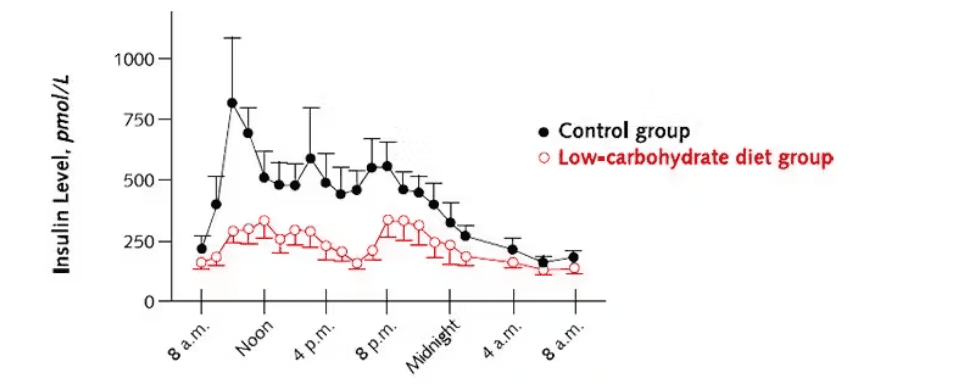
Photo source: Diet Doctor.
Many low carb specialists, notably Gary Taubes and the late Dr. Atkins, believe that decreased insulin levels are the primary reason for the diet's efficacy.
They believe that when carbohydrates are restricted, and insulin levels drop, fat is no longer "locked" up in fat cells and becomes available for the body to consume as energy, resulting in a reduced urge to eat.
However, I'd want to point out that many respectable obesity experts disagree, and they believe the evidence does not support the carbohydrate-insulin hypothesis of obesity.
Water Weight Drops Rapidly in The Beginning
People often lose much weight in the first 1-2 weeks of a low carb diet.
The primary cause for this is a drop in water weight.
The mechanism underlying it is twofold:
- Insulin: When insulin levels fall, the kidneys remove excess salt from the body, reducing blood pressure (15).
- Glycogen: The body stores carbs as glycogen, which binds water in the muscles and liver. When carbohydrate consumption decreases, glycogen stores in the body decrease, and water follows suit.
This does not occur to the same extent on a higher carb diet, even when calories are significantly lowered.
Even while some individuals use this as a reason to avoid low carb diets, losing water weight should be viewed positively.
Who wants to carry around extra bloat and water weight all the time?
Despite assertions, this is far from low carb diets' primary weight reduction benefit.
Studies indicate that low carb diets result in increased fat loss, particularly "dangerous" belly fat in the abdominal cavity (8, 16).
So, while reduced water weight accounts for some of the weight loss benefits of low carb diets, there is also a significant fat loss benefit.
Low Carb Diets Are High in Protein
Most research comparing low carb and low-fat diets shows that the low carb groups consume significantly more protein.
Individuals substitute numerous low-protein meals (grains, sweets) with high-protein foods such as meat, fish, and eggs.
Several studies have shown that protein reduces hunger, promotes metabolism, and aids muscle mass growth. Muscle mass is metabolically active and burns calories all day (17, 18, 19, 20).
Many nutritionists feel that the efficacy of low carb diets stems primarily from their high protein intake.
Low Carb Diets Have a Metabolic Advantage
Although this is debatable, many experts feel that low carb diets provide a metabolic benefit.
In other words, low carb diets boost energy expenditure, and people lose more weight than can be explained by calorie restriction alone.
There are various research that support this.
A 2012 study demonstrated that a very low carb diet boosted energy expenditure more than a low fat diet during weight maintenance (21).
The increase was around 250 calories, comparable to one hour of moderate-intensity daily activity!
Another research, however, suggests that the diet's high protein (but not low carb) component is responsible for the increase in calories burned (22).
That being said, other pathways might result in an extra metabolic benefit.
When carbohydrate consumption is kept exceedingly low on a very low carb, ketogenic diet, a large amount of protein is first converted into glucose, a process known as gluconeogenesis (23).
This inefficient method can result in hundreds of calories being "wasted." However, this is temporary since ketones should begin replacing part of the glucose as brain fuel within a few days (24).
Low Carb Diets Are Less Varied and Lower in “Food Reward”
Low carb diets immediately eliminate some of the world's fattening junk foods.
This includes sugar, sugary beverages, fruit juices, pizza, white bread, French fries, pastries, and most unhealthy munchies.
Eliminating most high-carb meals also results in a noticeable loss in variety, mainly because wheat, maize, and sugar are found in practically all processed foods.
It is generally understood that increasing meal diversity can lead to higher calorie consumption (25).
Many of these meals are also highly satisfying, and the reward value of foods influences how many calories we consume (26).
Limiting meal diversity and avoiding advantageous junk foods should help minimize calorie consumption.
Low Carb Diets Significantly Lower Your Appetite, Leading to Automatic Reduction in Calorie Intake
The substantial hunger-suppressing effects of low carb diets are most likely the most critical factor in their weight loss benefits.
It is widely proven that when people go low carb, their hunger decreases, and they begin to consume fewer calories spontaneously (27).
Research comparing low carb and low-fat diets typically limits calories in the low-fat groups while allowing the low carb groups to consume until full.
Regardless, the low carb groups often lose more weight.
Several probable causes exist for this appetite-reducing effect, some of which we have already discussed.
Increased protein consumption is a key contributor, although there is evidence that ketosis can significantly impact (28).
Many people who follow a ketogenic diet believe they only need one or two meals daily. They don't get hungry as much.
There is also evidence that reduced carb diets help improve appetite-regulating hormones such as leptin and ghrelin (29).
The Long Term Effects of Weight Loss Are Not Very Impressive
Low carb diets are successful in the short term, but the long-term outcomes are not as good.
Most studies span 1-2 years and reveal that the difference between the low carb and low-fat groups gradually vanishes.
There are several conceivable causes for this, but the most likely is that individuals eventually stop the diet and begin gaining weight again.
This is not unique to low carb diets and is well-documented in most long-term weight loss trials. Most "diets" are complicated to maintain.
The Bottom Line
Some individuals refuse to recognize that low carb diets work and that people may eat as much as they want, since it contradicts the calories in, calories out principle.
However, as you understand the principles underlying low carb diets, you will notice that the CICO model is not violated, and the laws of thermodynamics continue to apply.
The fact is that low carb diets benefit both sides of the calorie issue.
They increase your metabolism (calories out) and reduce your hunger (calories in), resulting in automatic calorie restriction.
Calories still matter; however, low carb diets automate the process and help minimize conscious calorie restriction's most common adverse effect: hunger.








0 Comments